
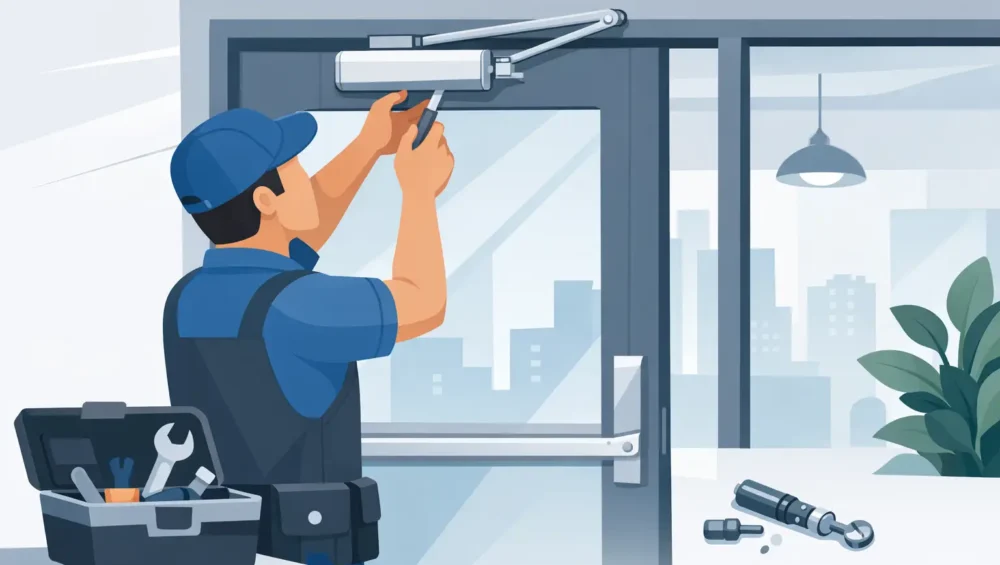
A front door that slams, drifts open, or refuses to latch is not a small annoyance – it is a business problem. Commercial door closer repair matters because that one piece of hardware affects security, safety, accessibility, energy efficiency, and the way customers experience your property the moment they walk in.
In retail stores, offices, schools, apartment buildings, and storefronts across the DMV, door closers take a beating. They open and close hundreds of times a day. Weather changes affect pressure and speed. People pull too hard, prop doors open, or ignore early warning signs until the closer starts leaking oil or the door stops closing properly. By the time the issue is obvious, the door may already be damaging the frame, misaligning the latch, or creating a safety risk.
What a commercial door closer actually does
A commercial door closer controls how a door closes after it is opened. It keeps the door from swinging freely, slamming shut, or staying partly open when it should be secure. Most closers use hydraulic pressure and spring tension to manage sweep speed, latch speed, and backcheck.
That matters more than many property owners realize. If the closer is set too fast, the door can slam and damage glass, hardware, or fingers. If it is too slow, the door may not latch, which leaves the building vulnerable and can affect HVAC performance. On entry systems with aluminum storefront framing and glass, poor closing action also puts extra strain on pivots, hinges, locks, and rails.
Signs you need commercial door closer repair
Some door closer problems are obvious right away. Others start small and get worse over time. If a commercial door is behaving differently than it used to, the closer should be inspected before the issue spreads to other parts of the opening.
The most common warning signs are a door that slams, closes too slowly, sticks before latching, swings unevenly, leaks fluid, or makes grinding or popping sounds. You may also notice that employees start pulling the door shut by hand because it no longer closes reliably on its own. That usually means the closer is out of adjustment, worn out, or no longer matched to the weight and use level of the door.
A misaligned door can look like a closer problem too, and sometimes it is both. If the frame shifts, the hinges wear down, or the lock and strike no longer line up, the closer has to work harder. In those cases, adjusting the closer alone will not solve the root problem.
Why commercial door closers fail
Heavy use is the most common reason. A door in a busy office or retail space may cycle constantly all day long. Over time, seals wear out, mounting screws loosen, arms bend, and internal components lose their ability to control motion.
Improper installation is another frequent cause. A closer that is undersized, mounted in the wrong position, or paired with the wrong arm type will never perform the way it should. This is especially common after quick patch jobs where someone replaces the hardware without checking door width, swing, traffic level, or ADA requirements.
Weather also plays a role. Exterior doors in the DMV deal with heat, cold, humidity, and wind pressure. A closer that seems fine in mild weather may start acting up during seasonal changes. If a closer is already near the end of its life, temperature swings can expose the problem fast.
Then there is misuse. Doors get propped open with wedges, forced beyond their intended swing, or pulled against resistance when the closer is already failing. That adds stress to the arm, bracket, and mounting points. In glass and storefront systems, repeated abuse can also loosen related hardware and create more expensive repairs.
Repair or replace? It depends on the condition
Not every failing closer needs full replacement. In many cases, a professional can adjust closing speed, tighten mounting hardware, correct arm position, or address minor wear before the problem turns serious. If the closer body is intact and there is no fluid leak, repair may be the right move.
Replacement makes more sense when the closer is leaking, the internal spring is failing, the body is cracked, or the unit has simply reached the end of its service life. It is also the better option when the current closer is the wrong type for the door. Installing another quick fix on bad hardware usually costs more in the long run.
This is where experience matters. The right decision is not just about what is broken today. It is about traffic volume, door weight, fire-rating requirements, accessibility standards, and whether the surrounding hardware is still in good shape. A proper service call should look at the full opening, not just the closer body.
Commercial door closer repair for storefront doors
Storefront doors need special attention because the closer is often part of a larger aluminum and glass system. If the door is dragging, not latching, or closing unevenly, the closer may be only one part of the issue. Bottom pivots, top pivots, threshold hardware, lock alignment, and frame movement can all affect performance.
That is why commercial door closer repair on storefront entrances should be handled with a system-wide view. Replacing one component while ignoring worn pivots or a damaged rail can leave the door unreliable. For businesses, that means repeated service calls, more downtime, and a front entrance that still does not feel right.
For customer-facing properties, appearance matters too. A shaky, slamming door gives people the impression that the property is not maintained. A properly repaired entrance feels controlled, safe, and professional from the first touch.
Why fast service matters for business owners and property managers
When an entry door is not working correctly, the effects show up quickly. Employees may struggle to secure the building at closing time. Customers may find the door hard to open or unsafe to pass through. Heating and cooling costs can increase if the door does not shut fully. In some buildings, a bad closer can even affect code compliance and fire door function.
For property managers, the bigger risk is delay. A closer issue that starts as an adjustment can turn into a damaged frame, broken lock, cracked glass, or emergency service situation if the door is allowed to keep slamming or sagging. Acting early is usually the cheapest and least disruptive option.
That is why responsive local service matters. In high-traffic commercial spaces, waiting days for a callback is not practical. You need a contractor who can assess the problem, explain whether repair or replacement is the smarter move, and get the entrance back to working condition without dragging out the process.
What to expect during a professional repair visit
A solid commercial door service call should start with inspection, not guesswork. The technician should check the closer body, arm, mounting points, latch alignment, hinges or pivots, frame condition, and overall swing path. If the door is glass or aluminum storefront, the rest of the entrance system should be evaluated too.
From there, the repair may involve adjusting sweep and latch speed, resetting arm tension, tightening loose hardware, remounting the closer, or replacing failed components. If the closer is beyond repair, the replacement should be selected based on the actual door and use conditions, not just what happens to be on the truck.
Good service also means clear communication. Property owners should know what failed, what was corrected, and whether any related hardware is likely to need attention soon. That kind of straightforward guidance helps prevent repeat issues and surprise costs.
Choosing the right contractor for commercial door closer repair
Not every handyman or glass company handles commercial door hardware well. The right contractor should understand closers, storefront doors, aluminum framing, and the way one failing component can affect the whole opening. They should also be able to respond quickly when the issue affects security or daily operations.
In the DMV, many businesses need a company that can do more than swap one part. They need a team that can repair the closer, address related door or glass issues, and keep the property functional without sending them to three different vendors. That is where a full-service company like Freddy Glass & Doors brings real value.
If your commercial door is slamming, sticking, leaking, or no longer closing the way it should, do not wait for it to become a larger repair. A working entrance protects your property, supports daily business, and gives every visitor a better first impression. The best time to fix it is when the problem is still manageable.